Sea State Recap: Developing the Blue Economy and Supporting Working Waterfronts
Perspectives | Feb 4, 2026
At our latest Sea State Seminar, we turned our attention to the people and places that keep Maine’s coastal economies alive. Framed by the theme of “Imagining 2030,” this event focused on the opportunities and pressures around developing our region’s blue economy and helping working waterfronts thrive. Together, Jonathan Labaree, GMRI Chief Community Officer, and Graham McKay, Executive Director of Lowell’s Boat Shop, explored how balancing innovation, heritage, and investment is key to shaping the future of our region’s blue economy and helps pave the way for the future of our working waterfronts and the communities they support.
Honoring the Past to Prepare for the Future
Graham McKay opened with the story of Lowell’s Boat Shop, a facility founded in 1793 and recognized as the oldest continuously operating boat shop in the United States. McKay traced the shop’s legacy from its heyday producing thousands of fishing dories in the late 19th and early 20th centuries, to its evolution into a hub for cultural preservation, skill-building, and community engagement.
He described how the shop integrates traditional boatbuilding practices with a modern mission to educate and empower youth. A centerpiece of this effort is their yearlong apprenticeship program for high school students. “We've had people come back five years later and say, ‘I was part of that project and it changed my life.’” Apprentices engage directly with the tools, techniques, and mentorship needed to pursue careers in marine trades — and, as McKay emphasized, they also develop a strong sense of belonging and pride in contributing to something tangible and lasting.
This hands-on training is not just about craftsmanship. McKay highlighted the role Lowell’s plays in revitalizing the town’s connection to the river and its maritime heritage. “The boat shop has become the identity of the town of Amesbury, and people have embraced it.”
He also noted the importance of functionality alongside tradition: “In our case, it's a balance between functionality and tradition. People come to us for a traditional boat… but they're not going to keep coming to us if it's not functional.”
Through apprenticeships, public programs, and production work, Lowell’s has become a working example of how heritage and innovation can coexist — and thrive — on a working waterfront.
Charting a Path Forward for Coastal Economies
Jonathan Labaree provided a wide-lens view of the systems that support Maine’s coastal economies, particularly the seafood supply chain. He outlined the journey of seafood from ocean to table, describing the key roles of harvesters, dealers, processors, distributors, and retailers.
“Portland's seafood economy is this entire supply chain in a microcosm, and it's all happening within a half mile of the working waterfront,” Labaree explained.
He emphasized that none of this is possible without physical access to the ocean. “You can't gain access to the products that are out in the ocean unless you can actually get to the ocean. And that's a real vulnerability.”
Labaree illustrated how Maine’s coastal communities are navigating a complex mix of development pressure, infrastructure aging, and climate uncertainty. He described tools like harbor zoning overlays, current use taxation programs, and working waterfront covenants that aim to protect access — but acknowledged that these tools alone are not enough. “We're finding in our conversations with wharf owners and others up and down the coast that we need some more tools.”
You can't gain access to the products that are out in the ocean unless you can actually get to the ocean.
![]() Jonathan Labaree Vice President, Community
Jonathan Labaree Vice President, Community
He pointed to our acquisition of Union Wharf as a proactive investment in preserving and evolving working waterfronts. “We're trying to create something that is... not just a time capsule of the working waterfront in 2023, but something that’s going to last for 20, 30, 40 years into the future,” he said.
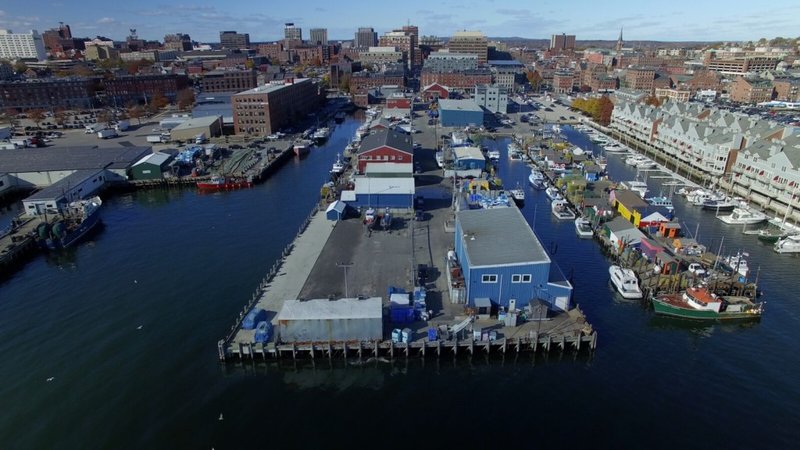
This effort, he explained, reflects a broader shift in how we think about coastal infrastructure — not only as a foundation for traditional industries like fishing, but as an adaptable platform for aquaculture, marine research, education, and emerging technologies. By fostering collaborative approaches and expanding policy frameworks, Labaree emphasized the importance of supporting diverse, future-ready uses of the waterfront.
Community, Culture, and Continuity
Throughout the evening, both speakers emphasized that resilience is not just about infrastructure — it’s about people. McKay shared the impact of Lowell’s youth programs and apprenticeships, noting how students return as employees, volunteers, and advocates. “What this has done, certainly for us over the last 10 years, is created an army of young people who care,” he said.
Labaree echoed the need for policy and investment that reflect the full range of users and industries, from traditional fisheries to aquaculture, education, and innovation. “The blue economy and the working waterfront really is where everything comes together — the industries, the people, the infrastructure,” he said.
Ultimately, the conversation underscored the value of preserving identity while welcoming change. From Lowell’s adaptive boat designs to Portland’s layered zoning tools, the evening highlighted the balance between honoring tradition and preparing for the future.
As coastal communities navigate environmental, social, and economic shifts, places like Lowell’s Boat Shop and initiatives like our Union Wharf project offer glimpses of what’s possible: rooted, resilient, and ready to evolve.